SEO Competitor Analysis: A Practical Guide for Business Owners

An SEO competitor analysis shows you which sites Google rewards for the searches your customers make, and exactly where they beat you. The hard part is not collecting the data. It is deciding which gaps are worth closing for your size, budget and market, then executing on them. That is where our testing-driven approach at Affordableseoexpert earns its keep: we turn a pile of spreadsheet rows into a short list of actions that move rankings and revenue.
TL;DR
- Your SEO competitors are the sites that repeatedly appear on page one for your target searches. They are often not the businesses you compete with in person.
- Run a keyword gap check, read the search results for intent, compare content, then compare backlinks and technical health.
- A content gap is a topic or keyword your rivals rank for and you do not. Rank the gaps by impact and effort, not by search volume alone.
- Repeat the analysis at least quarterly and after any significant ranking drop.
- The analysis only pays off when someone executes the findings. We build custom SEO plans around what testing shows is working.
Table of Contents
- What an SEO competitor analysis actually is
- Step 1: Identify your real SEO competitors
- Step 2: Run a keyword gap analysis
- Step 3: Read the search results for intent
- Step 4: Compare content, and find the content gaps
- Step 5: Compare backlinks
- Step 6: Check technical health and AI visibility
- Step 7: Turn findings into a prioritized plan
- How often to repeat it
- Where doing it yourself stops paying off
- FAQ
What an SEO competitor analysis actually is
It is a structured review of the sites that outrank you, covering their keywords, content, backlinks and technical setup, so you can see what works in your market. Ahrefs describes it as digging into rivals’ strategies to find their strengths and weaknesses so you can outrank them. The point is to learn and apply, not to copy.
For a small business the payoff is focus. Rankings matter a lot at the top: Backlinko’s click study reported the first organic result earns about 27.6% of clicks, with position two at 15.8%. Knowing which pages hold those spots, and why, tells you where effort will actually change your lead flow.
Step 1: Identify your real SEO competitors
Your SEO competitors are whoever Google shows for your searches. HubSpot’s method is simple: search your top five target keywords in an incognito window, write down every domain on page one, and keep the ones that show up repeatedly.
Expect surprises:
- Local service providers (roofers, HVAC, electricians, pest control, junk removal) often compete with directories, review sites and lead-generation marketplaces as well as the company down the street.
- Dentists, chiropractors, med spas and plastic surgeons face rival practices, but also health information sites and aggregator listings.
- Lawyers, estate planning attorneys and financial advisors compete with legal and finance publishers for informational searches, and with other firms for “near me” searches.
- Restaurants compete with review platforms and “best of” lists as much as with other restaurants.
- SaaS and ecommerce brands compete with comparison articles, forums and marketplaces.
Aim for three to five competitors. Also check their strength before you pick targets: Ahrefs advises that a mid-authority site should benchmark against mid-authority rivals, not the biggest brands in the category, which have a built-in advantage.
Where it goes wrong: choosing competitors by gut feeling. Two firms you know well may rank for almost nothing you care about, while an unknown site takes your best searches.
Step 2: Run a keyword gap analysis
A keyword gap compares the searches your competitors rank for with the ones you rank for. Most major SEO platforms offer it. HubSpot’s workflow enters your domain plus up to four competitors, then filters for two groups:
- Missing keywords: competitors rank in the top 20, you do not appear.
- Weak keywords: you rank, but competitors sit much higher.
Sort by search volume and keyword difficulty, export the list, then keep only what fits your business. A plastic surgeon does not need a ranking for a generic cosmetic term that attracts students. A HVAC company wants emergency repair and installation searches in its service area.
Worked example
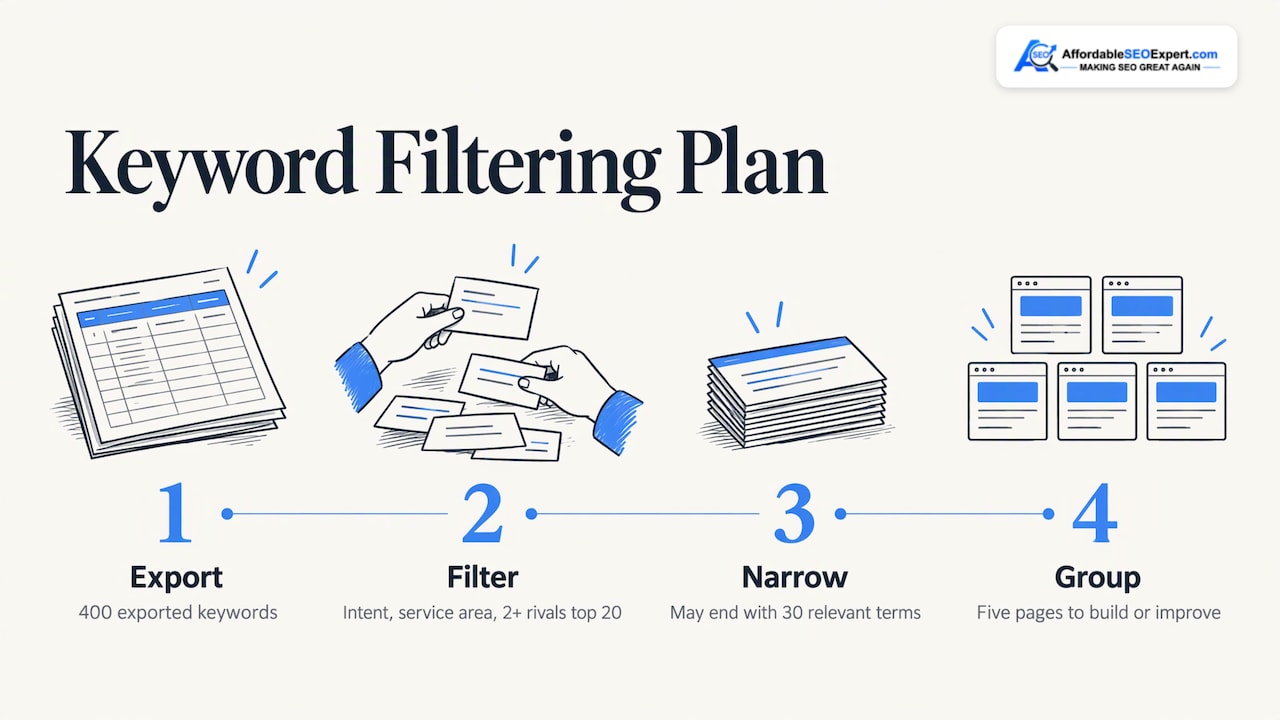
Say you run a roofing company and your export has 400 keywords. Cut it to terms with a clear buying intent (“roof replacement cost,” “storm damage roof repair”), your service area, and positions where two or more competitors rank in the top 20. You may end up with 30 keywords. Group them into five pages you can build or improve. That is a plan. Four hundred rows is not.
Step 3: Read the search results for intent
A keyword is only worth chasing if you can serve what the searcher wants. Open the results and note what Google shows: service pages, blog guides, product listings, maps, comparison lists. If page one is all local service pages with a map, a long blog post will not win. If it is all guides, a sales page will not either.
This step is where template-driven SEO fails. Our approach starts with customer search intent and builds the page type the results reward, rather than reusing one format for every client.
Step 4: Compare content, and find the content gaps
A content gap is a keyword or topic that competitors cover and you do not. Ahrefs treats content gaps and keyword gaps as the same thing. But Search Engine Land argues a real gap analysis goes further: where rivals cover a topic more thoroughly, where their sites are easier to crawl, where they earn stronger links, and where they show up in AI answers.
How to find content gaps
- List your competitors’ best pages for the shared keywords from Step 2.
- Compare coverage. Do they answer questions you skip, such as pricing, process, timelines, comparisons, FAQs?
- Check structure. Clear headings, short definitions, FAQs and comparison blocks help pages appear in snippets, People Also Ask boxes and AI answers, according to the same Search Engine Land guide.
- Check freshness. Thin or outdated pages are cheap wins: refresh them with missing sections, examples and entities instead of writing from scratch.
- Map each gap to a page: a new page, an expansion, or a refresh.
Do not chase word count. Backlinko’s ranking study, as summarized by SEO Rocket, found an average first-page result of 1,447 words but no direct relationship between length and rankings. Match what the topic needs.
Step 5: Compare backlinks
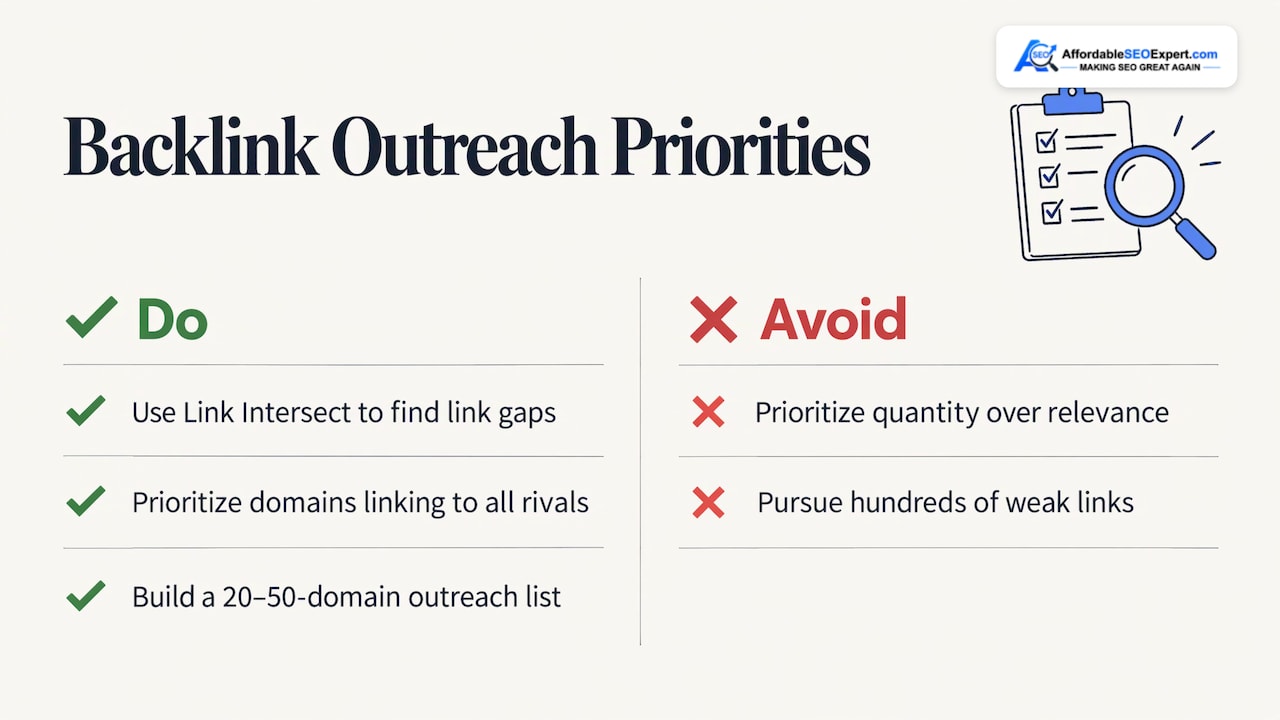
Links remain a major authority signal. A backlink gap shows sites that link to your competitors but not to you. In Ahrefs, the Link Intersect report does this: enter competitors on top, your domain below, then show link opportunities. Look for links that are easy to replicate, such as local directories, industry associations, supplier pages, press mentions and resource lists.
HubSpot suggests prioritizing domains that link to all your competitors and building an outreach list of 20 to 50 domains. A site linking to several rivals has already shown it links to businesses like yours.
Be selective. A few relevant links beat hundreds of weak ones. If you would rather not do outreach yourself, our link building services cover this work, and published one-off packages start at $299 for 5 backlinks.
If you want to go deeper on tool differences, we compare which is better for backlink analysis and explain why rankings differ between tools.
Step 6: Check technical health and AI visibility
Compare crawlability, page speed, mobile experience, structured data and internal linking against your rivals. A competitor with a clean, fast site and clear schema can outrank a stronger brand. If you find your site is the one with the problems, a technical audit comes before content.
Also check whether competitors are cited in AI answers. Search Engine Land’s 2026 guide now includes LLM visibility in competitor analysis. Ask the questions your customers ask in ChatGPT, Gemini and Google’s AI Overviews, and note who gets named. This matters: an Ahrefs study of 300,000 keywords, cited by HubSpot, linked AI Overviews to a 58% lower average clickthrough rate for top-ranking content. Being the source the AI cites is becoming part of ranking well, which is why we offer AI SEO optimization.
Step 7: Turn findings into a prioritized plan
Search Engine Land recommends sorting every finding into three groups: high impact and low effort (quick wins), high impact and high effort (larger projects), and low impact (set aside). Here is how that looks for a small business:
| Priority | Typical finding | Action |
|---|---|---|
| Quick win | Page ranks 4 to 15 for a money keyword | Refresh content, add FAQs, improve internal links |
| Quick win | Competitor lists on a local directory you are not on | Claim the listing, fix name, address and phone consistency |
| Larger project | No page for a high-intent service or location | Build a dedicated page with proof, pricing context and FAQs |
| Larger project | Competitors have 30 more relevant referring domains | Run a steady link campaign |
| Set aside | High-volume, low-intent keywords | Ignore for now |
A 90-day rhythm works well: quick wins in the first month, content authority in the second, links and AI optimization in the third. Set a clear goal first. Shopify’s SEO team lead recommends deciding whether you want broad traffic, conversion-driving topics or a balance, so decisions stay aligned with business goals.
How often to repeat it
HubSpot recommends a full analysis at least quarterly, plus a targeted one after any significant ranking drop. Search Engine Land makes the same point: competitors publish, search behavior shifts and your own authority changes. Run one also when you launch a new site or plan a new SEO strategy.
Where doing it yourself stops paying off
The analysis is the easy half. The cost is in interpreting it: which of 400 keywords is worth a page, which links are worth earning, which fixes unlock the rest. Our work is custom-built for each client, based on continuous testing of what drives rankings and revenue, not template tactics. Our founder, Anatoly Zadorozhnyy, has over 18 years of SEO experience.
We work with local service providers, professionals such as lawyers, dentists and plastic surgeons, ecommerce brands and SaaS teams. Local and small business SEO starts at $999 per month, and national SEO, ecommerce and SaaS engagements start at $1,699 per month. See the local SEO and ecommerce SEO pages, or talk to us about a competitor-driven SEO plan.

If budget is your first question, our breakdown of whether SEO is worth the money walks through the return for a small business.
FAQ
What are SEO competitors?
They are the sites that rank on page one for the searches you want to win. They may be business rivals, but also directories, publishers, review sites or forums. Search your main keywords in an incognito window and note the domains that keep reappearing.
What is a content gap analysis?
It compares your content with competitors’ to find topics and keywords they cover and you do not. It also shows where their pages are more thorough, better structured or better linked. The output should be a ranked list of pages to create or improve.
What are the four parts of a competitor analysis?
For SEO, the core parts are keywords, content, backlinks and technical health. Many teams now add a fifth: visibility in AI answers. Keep each comparison tied to the same set of three to five true competitors.
How often should I run one?
At least once a quarter, and again after any significant ranking drop. Faster-moving industries benefit from a shorter cycle. Each round should refresh the competitor list and review the actions from the last one.