Technical SEO Services: What You Get and How to Choose

Technical SEO services fix the site-level problems that stop Google from crawling, rendering, indexing and serving your pages correctly. If your content is good and your rankings still stall, the cause is often technical. That cause usually shows up in crawl errors, slow templates, broken redirects or a site structure that hides your best pages. We handle this work as part of our SEO consulting and monthly packages, led by Anatoly Zadorozhnyy, who has more than 18 years of experience.
This guide explains what the work covers, which issues it solves, how a good engagement runs and what to ask before you sign. It is written for owners and marketing leads at local service businesses, eCommerce stores, SaaS companies and professional practices.
TL;DR
- Technical SEO is the infrastructure layer of search: crawling, rendering, indexing and serving content correctly and efficiently.
- A real engagement covers an audit, a prioritized fix list, implementation support and monitoring, not just a PDF of warnings.
- Site architecture, indexing and speed come first. Fancy extras come after the basics work.
- Redesigns, migrations, new sites and large catalogs are the moments when expert help pays back fastest.
- Our SEO plans start at $999 per month for local and small businesses and $1,699 per month for national, eCommerce and SaaS sites.
Table of Contents
- What technical SEO services are
- What a technical SEO engagement includes
- Technical issues these services fix
- Site architecture: the part most owners overlook
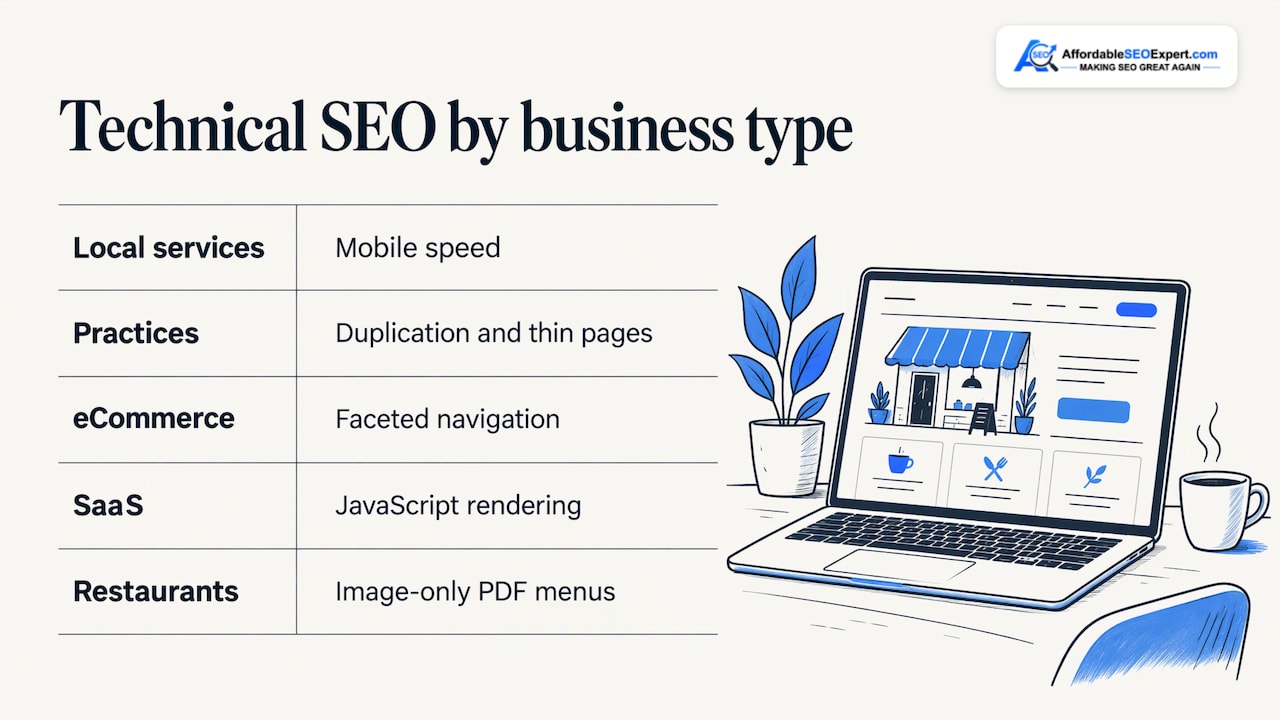
- How technical SEO differs by business type
- What technical SEO consulting costs
- When to bring in a technical SEO expert
- How to choose a technical SEO provider
- Technical SEO with Affordable SEO Expert
- What to expect after the fixes
- FAQ
- Sources
What technical SEO services are
Search engines work in stages. A crawler finds your URLs, the system renders the page the way a browser would, the page is stored in an index, and then it is eligible to be shown for a query. Technical SEO makes each stage easy. Search Engine Land’s guide describes it as optimizing website infrastructure so search engines can crawl, render, index and serve content correctly and efficiently.
It differs from the two other branches of SEO:
- On-page SEO is the content and markup of a page: titles, headings, copy, internal anchors. Our explainer on what on-page SEO is covers it.
- Off-page SEO is external authority, mainly links from other sites.
- Technical SEO is the backend access and configuration that lets the first two work at all.
A page with perfect copy that Google cannot index earns nothing. That is why on-page work alone rarely gets a site onto page one, and why technical work often sits at the start of an engagement.
Google itself lists this kind of help among the services an SEO can provide. Its guidance on hiring an SEO mentions reviewing site content or structure and giving technical advice on hosting, redirects, error pages and JavaScript.
What a technical SEO engagement includes
The scope varies by site, but the work falls into five parts.
1. The technical audit
The audit is a full crawl and review of how search engines see your site, compared with how you think they see it. It looks at indexation status, response codes, redirects, canonical tags, robots rules, sitemaps, structured data, mobile rendering and page speed. The output that matters is not the list of problems. It is the order in which to fix them.
2. A prioritized fix list
Every audit tool produces hundreds of warnings, and most do not move rankings. A consultant’s job is to separate what blocks revenue pages from what is cosmetic. Each item should say what is wrong, which URLs it affects, what to change and what result to expect.
3. Implementation support
This is where many projects fail. An Aira survey cited by Search Engine Land in March 2026 found that up to 67% of respondents named non-SEO development work as the biggest obstacle to implementing technical SEO changes. Fixes sit in a developer backlog while traffic suffers. Our approach centers on real-world implementation rather than generic recommendations, so the fix list is written to be built, not just read.
4. Migration and redesign protection
A redesign, a platform change or a domain move is the riskiest moment for organic traffic. The technical work typically includes mapping old URLs to their new equivalents with redirects, checking the staging site, verifying launch behavior and monitoring performance afterward. Google notes that hiring an SEO may be helpful when you are considering a redesign or launching a new site.
5. Ongoing monitoring
Sites break quietly. A plugin update adds a noindex tag, a developer blocks a folder in robots.txt, a template change doubles your page weight. Regular checks catch these before they show up as lost leads.
Technical issues these services fix
Here are the problems that come up most often, with what each one costs you.
| Issue | What goes wrong | Typical fix |
|---|---|---|
| Indexing blocks | Revenue pages carry a noindex tag or are blocked in robots.txt, so they never appear in results | Correct the directive, resubmit the URLs |
| Duplicate URLs | Filters, parameters and www/non-www versions split signals across copies of one page | Canonical tags, redirects, parameter handling |
| Broken redirect chains | Old URLs pass through several hops or end on 404 errors | Point each old URL straight to its final destination |
| Orphaned and buried pages | Pages with no internal links, or sitting many clicks from the homepage, are rarely found or valued | Rebuild navigation and internal links |
| Slow or unstable pages | Heavy images, scripts and layout shifts frustrate visitors | Compress, defer, reserve space for elements |
| Missing or wrong structured data | Search engines cannot confirm what a page is about | Add schema that matches visible content |
| JavaScript rendering gaps | Content that loads only after scripts run may not be seen | Server-side or pre-rendered output for key content |
Crawl waste on large sites
On big eCommerce catalogs, Google can spend its crawling time on thousands of near-identical URLs instead of your products. Google’s crawl budget documentation recommends consolidating duplicate content and using robots.txt to block crawling of URLs that should not be crawled. For a store with faceted navigation, this is often the single biggest technical win. Our eCommerce SEO services are built around this kind of catalog problem.
Page experience and speed
Google’s Core Web Vitals give you concrete targets. Web.dev says the largest content element should load within 2.5 seconds of when the page starts loading to give a good experience. Responsiveness and layout stability have their own thresholds on the same page. A technical review measures your key templates, such as the homepage, a service page and a product page, against these targets and traces slow loads to specific causes.
Site architecture: the part most owners overlook
Site architecture is how your pages are organized and linked. It decides which pages Google finds first, which it treats as important and how visitors move toward a call or a purchase.
Google’s long-standing guidance on link architecture recommends that important pages be reachable from the homepage, that links be crawlable text links with descriptive anchor text, and that a sitemap complement a crawlable linking structure rather than replace it.
Search Engine Land’s 2026 piece names the architecture issues worth investigating:
- pages buried more than four clicks from the homepage
- orphaned pages with no internal links
- weak internal linking
- competing pages that target the same topic
- competing taxonomies, such as two category systems covering the same products
It also advises arranging content around search themes and linking related pages to the key landing pages.
Here is a practical example. A dental practice has one page per treatment, but also a blog post for each treatment and three city pages that all list the same treatments. Google sees six pages competing for “dental implants.” Architecture work picks one page to rank, turns the others into supporting pages that link to it and removes the overlap. Nothing new is written, yet the signal is clean.
The same logic applies to a SaaS company with feature pages, use-case pages and a docs section that all describe the same capability. Restructuring so each topic has a single clear home helps both searchers and AI answer engines pick the right page.
How technical SEO differs by business type
Local service businesses (HVAC, roofing, electricians, pest control, junk removal). Sites are usually small, so the technical priorities are mobile speed, clean service-area page structure, correct local business schema and consistent site signals that support your Google Business Profile. See our local SEO services.
Professional practices (lawyers, dentists, chiropractors, plastic surgeons, med spas, financial advisors, estate planning). Practice sites often grow by adding a page per procedure or practice area, which creates duplication and thin pages. Structured data, clear hierarchy and fast mobile pages matter, and so does making your content easy for AI answer systems to read. Our AI SEO optimization services address that side.
eCommerce. Faceted navigation, product variants, pagination, out-of-stock handling and page weight are the recurring themes.
SaaS. JavaScript rendering, subdomain strategy, documentation structure and programmatic pages need careful handling.
Restaurants. Menus saved as image-only PDFs, slow mobile pages and missing location and hours markup are frequent issues.
What technical SEO consulting costs
Prices differ widely by site size, platform and how much implementation is included, so a single industry average would mislead you. What drives the price:
- Site size. A 40-page service site and a 200,000-URL catalog are different projects.
- Platform limits. Some CMS and store platforms restrict what can be changed.
- Implementation scope. A report alone costs less than a report plus hands-on fixes.
- Ongoing vs one-time. A migration is a project. Monitoring and improvement is monthly.
- Developer access. Fixes that need your developers take coordination.
Our published pricing, as read from our site on November 16, 2026:
| Plan | Price |
|---|---|
| Local / Small Business SEO | from $999 per month |
| National SEO / eCommerce / SaaS / Other | from $1,699 per month |
Technical SEO is one of the services within these engagements, alongside on-page work, content strategy, local SEO and link building. If you are weighing the return on a monthly budget, our honest ROI breakdown for small businesses walks through the math.
When to bring in a technical SEO expert
Google says hiring an SEO can improve a site’s visibility and save you time, and that it can help with a redesign, a new site launch or an existing site. These are the signals that the time is right:
- You are planning a redesign, platform change or domain move.
- Pages you expect to rank do not appear in Google’s index.
- Traffic dropped after a site update and nobody can say why.
- You run a catalog or multi-location site with thousands of URLs.
- Your developers need a clear, ranked list of what to build and why.
- You want your pages to be readable by AI answer engines as well as classic search.
If resources are tight, Search Engine Land advises putting site architecture and essential crawling and indexing work first instead of trying to do everything at once. That is the order we work in.
How to choose a technical SEO provider
Google’s hiring guidance says to research the benefits and risks, check references, ask for realistic estimates and request explanations of recommendations and changes. Its warning is that an irresponsible SEO can damage your site and reputation. Turn that into specific questions:
- Who does the work? Ask whether the person who audits your site also directs the fixes. Our work is led by Anatoly Zadorozhnyy directly.
- Is the strategy custom? Your site’s problems are not a template. Our strategies are built for each client and shaped by continuous testing of what drives rankings.
- What does implementation look like? A deliverable that stops at a report leaves the hardest part to you.
- How are priorities set? Look for ranking by revenue impact, not by tool severity scores.
- How is progress reported? Expect crawl, indexing, traffic and lead measures tied to the changes made.
We have also written about questions to ask an SEO expert before you hire them, red flags that should make you walk away and whether a solo expert or an agency suits you.
Technical SEO with Affordable SEO Expert
Our technical SEO sits inside custom SEO engagements that also cover on-page optimization, content strategy, keyword and search intent research, Google Business Profile and local SEO, authority link building, entity optimization and AI SEO. That means the technical foundation and the work that builds on it are planned together, with the same testing and data-driven approach.
Local and small business plans start at $999 per month, and national, eCommerce and SaaS plans start at $1,699 per month. Larger sites can look at our corporate SEO and enterprise SEO services. To talk through your site, start at our SEO consulting page.

Once the site is technically sound, authority is the next lever. Our link building services and one-off packages in the shop put that foundation to work.
What to expect after the fixes
Technical fixes rarely produce an overnight jump. Google has to recrawl changed pages and reassess them, so improvements appear over weeks, and the largest gains tend to come on sites where indexing or architecture problems were hiding good content. A sensible first-quarter plan looks like this:
- Weeks 1 to 2: crawl, audit and prioritize.
- Weeks 2 to 6: implement the blocking fixes, such as indexing, redirects and canonicals.
- Weeks 6 to 12: address architecture, internal links and speed on key templates, then measure indexing and organic traffic against the starting point.
These are planning ranges, not guarantees, since timing depends on your platform and how quickly changes can be released.
FAQ
What are technical SEO services?
They are the work of making your website easy for search engines to crawl, render, index and serve. That covers audits, fixing indexing blocks, redirects, duplicate URLs, site structure, structured data and page speed. They support your content and links by removing what holds them back.
What is an example of technical SEO?
A common example is fixing redirects during a redesign. Each old URL is mapped to its closest new page so rankings carry over and visitors do not hit error pages. Another is adding canonical tags so duplicate product URLs point to one preferred version.
How much does technical SEO cost?
It depends on site size, platform, and whether fixes are implemented for you. Our SEO engagements, which include technical work, start at $999 per month for local and small businesses and $1,699 per month for national, eCommerce and SaaS sites.
Do I need a technical SEO expert if my site is small?
A new site, a redesign or a sudden traffic drop are the clearest reasons to bring one in, whatever the site’s size. An expert reviews structure, indexing and speed so the content you publish can actually perform. Local service sites often see value from a one-time cleanup followed by monitoring.
Sources
- What Is Technical SEO? The Definitive Guide, Search Engine Land
- Where to focus technical SEO when you can’t do it all, Search Engine Land
- Do You Need an SEO? Tips for Hiring an SEO, Google Search Central
- Importance of link architecture, Google Search Central
- Crawl Budget Management, Google Search Central
- Web Vitals, web.dev
- Technical SEO Services: What’s Included and What It Costs, Outrank