How the May 2026 Core Update Broke SEO Tracking As We Knew It

Something shifted in May 2026 that most SEOs weren’t ready for – and I don’t mean the typical “rankings dropped, rankings recovered” cycle we’re all used to riding out. This was different. The May 2026 Core Update introduced what researchers and practitioners now call the Dynamic SERP phenomenon, fundamentally changing how search results behave for the same keyword across different users.
I want to break down exactly what happened, what the data actually show, and, more importantly, what it means for how you should run SEO campaigns going forward.
What Is the Dynamic SERP Update?
The term “Dynamic SERP” refers to a measurable pattern where Google began serving meaningfully different organic results for identical keyword queries to different users – even when those users are logged out, in similar locations, and using the same device type.
This isn’t theoretical. SEO professional Schieler De’Land first flagged the inconsistency publicly after noticing that users searching the same keywords were seeing completely different results. Local Search Forum members corroborated this, reporting tracking inconsistencies they couldn’t explain for geographically focused keywords they’d been monitoring for years.
The confusion escalated quickly because automated rank-tracking tools began reporting results that contradicted manual searches. That’s when people realized something structural had changed – not just fluctuations, but a new baseline behavior.
The Numbers Behind the Volatility
Yext conducted a detailed analysis of the post-update environment, and the findings were striking. Volatility spiked sharply beginning the week of May 18, 2026, right in line with the core update rollout. Across all reports analyzed, 97% showed increased volatility in search results.
Organic rankings experienced a 48.7% increase in volatility compared to pre-update baselines.
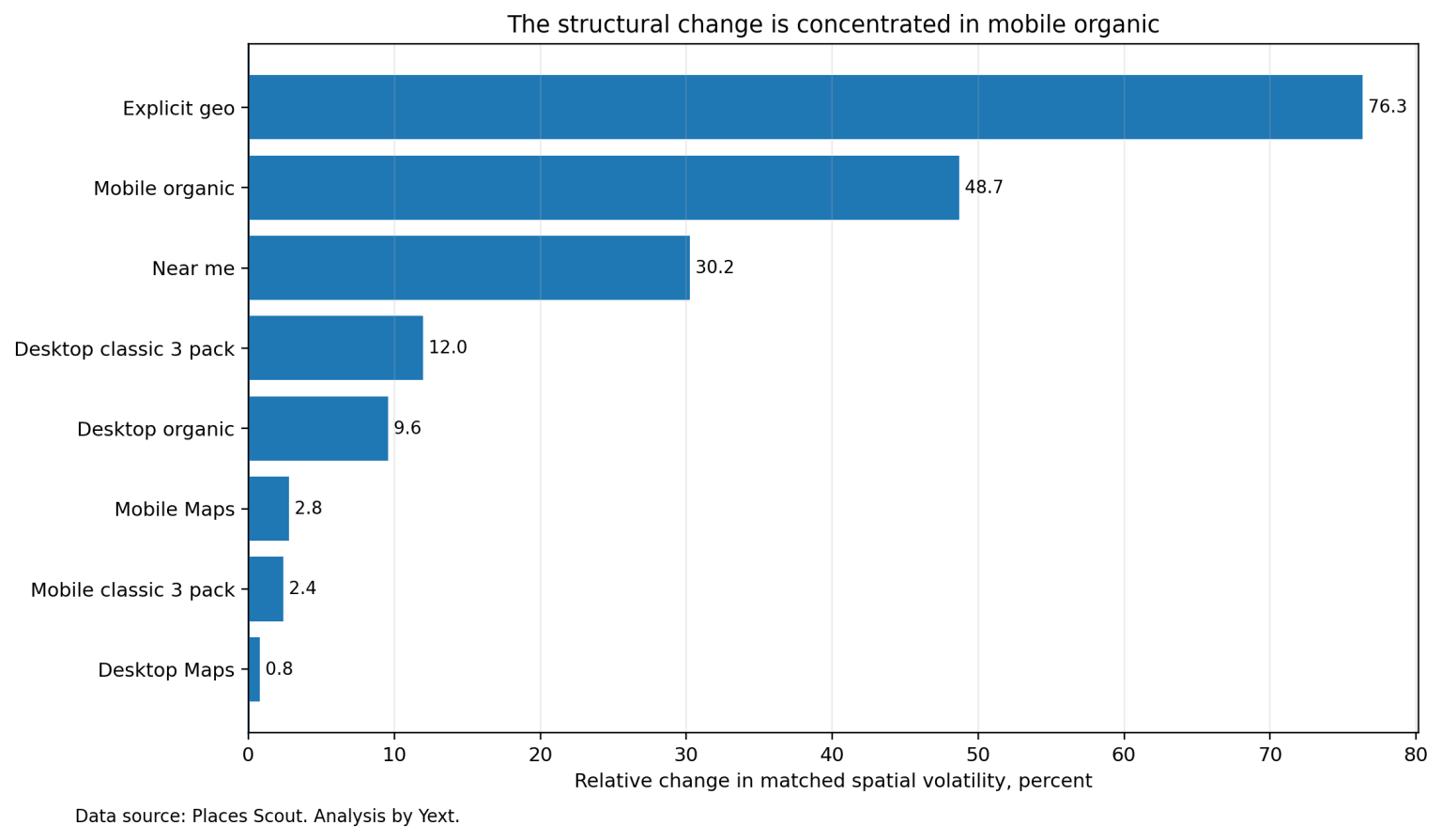
Mobile organic results for keywords with geographic modifiers – think “plumber near me” or “best dentist in Chicago” – showed the most severe fluctuations. Local pack results were also affected, though to a noticeably lesser degree than mobile organic. That gap matters because it suggests Google may now be treating these two surfaces under different algorithmic logic.
By August 2026, result patterns still hadn’t stabilized. That’s not a brief shakeout period. That’s Google operating at a new level of dynamic SERP that we have to treat as permanent until proven otherwise.
Personalization vs. Dynamic Delivery – Why the Distinction Matters
A reasonable first instinct is to chalk this up to Google’s personalization engine. Google has been tailoring results based on browsing history, location signals, and past interactions for years. But the Yext analysis specifically controlled for this – the data came from logged-out users, which effectively removes personal history as a variable.
So this isn’t your search history showing you different results than your colleague’s search history. This is Google dynamically serving different organic rankings to broadly similar users as a feature, not a side effect.
That distinction is critical for SEO strategy. Personalization is a user-level phenomenon. What we’re dealing with post-May 2026 is a systemic, algorithmic behavior affecting how rankings are distributed across an audience. If you’re advising a client that they rank #2 for their target keyword, that statement is now less meaningful than it was 18 months ago – because which users are seeing them at #2 versus #5 versus #8 is no longer consistent.
What This Breaks in Traditional SEO Workflows
Here’s where I have to be direct with clients and fellow practitioners: the standard rank-check workflow is now producing incomplete data at best, misleading data at worst.
Spot-checking your keyword rankings with a single tool query or a quick manual search gives you one snapshot of a distribution, not a reliable indicator of your actual visibility. It’s the equivalent of checking the stock market at exactly 10:03 AM every Monday and calling that your investment performance.
Daily rank tracking tools are similarly limited. When volatility is this pronounced and this persistent, a single daily reading captures noise rather than signal. You need trend data across multiple days, multiple user contexts, and multiple device types before you can draw meaningful conclusions about where you actually stand.
This is an expensive blind spot if you’re reporting rankings to clients as the primary performance metric. A client seeing you report “stable rankings” while their actual impression distribution has shifted dramatically will eventually notice it in their traffic and leads – and they’ll stop trusting the reports.
What Good Measurement Looks Like Now
I’ve shifted how I approach performance tracking in light of this, and I think any serious SEO operation should do the same.
Revenue and lead generation are the anchor metrics. I was always a believer in this, but the Dynamic SERP update makes it non-negotiable. Rankings are an input. Calls, form fills, booked appointments, and closed deals are the output. The output is what clients pay for and what actually tells you whether your work is producing results.
Call tracking is essential infrastructure, not optional. When you’re trying to figure out whether a specific page is driving inbound leads, you need call tracking in place. If your client’s phone rings, you need to know which page – and ideally which keyword – triggered that visit. Google’s volatility in ranking distribution makes this even more important because page-level performance data becomes your most stable signal.
UTM parameters on Google Business Profile links help identify which keywords are actually funneling users into the local experience versus the organic experience. With local pack and organic mobile results behaving under different dynamics post-update, separating these traffic streams gives you cleaner data to make decisions from.
Trend analysis over longer windows. A 90-day view now tells you more than a 7-day view ever did. Single scans and weekly snapshots are too susceptible to the volatility variance introduced by the Dynamic SERP behavior.
Industry-Specific Volatility Patterns
Not every market is experiencing this equally. Some industries appear to be seeing more pronounced Dynamic SERP behavior than others – particularly those with strong local intent signals embedded in their keywords.
Home services (HVAC, plumbing, roofing etc.), healthcare (urgent care, dentists, therapists), and legal services are categories where geographic modifiers are essentially mandatory for conversions. Those are also the categories where mobile organic volatility is hitting hardest, based on the pattern of geomodifier keywords being disproportionately affected.
If you’re running SEO for a national e-commerce brand with broad, non-local keyword targets, your exposure to this specific dynamic may be lower. If you’re running local SEO for service businesses – which is a significant portion of what I work on – you’re operating in the most turbulent part of the current SERP landscape.
Fluctuations Were Already There – The Update Amplified Them
One thing worth acknowledging: SERP volatility isn’t new. Results have always shifted. But what changed in May 2026 wasn’t the existence of fluctuation – it was the frequency, magnitude, and apparent permanence of it.
Pre-update fluctuations were often traceable to content updates, link profile changes, or competitive movements. They had a certain cause-and-effect logic. What we’re seeing now is volatility as a baseline condition, not as a reaction to specific events. That’s a different operating environment, and it requires a different mindset.
The Strategic Takeaway
I think the May 2026 Core Update signals something Google has been moving toward for a long time: the devaluation of a single, universal ranking position as a meaningful concept. Google wants to serve different results to different users based on signals we don’t fully see – and they’re getting better at it.
For SEOs, the practical response isn’t panic. It’s adaptation. Stop treating ranking positions as proof of success. Start treating them as one signal among many. Build client reporting around business outcomes. Invest in tracking infrastructure that captures the full conversion path. Monitor trends across longer time windows.
The SEOs who will struggle are the ones still promising “Page 1 rankings” as a deliverable without context. The SEOs who will thrive are the ones who help clients understand how search is working now – dynamically, variably, and increasingly individualized – and who measure performance against the outcomes that actually fund businesses.
That’s always been the right approach. The May 2026 update just made it impossible to avoid.